


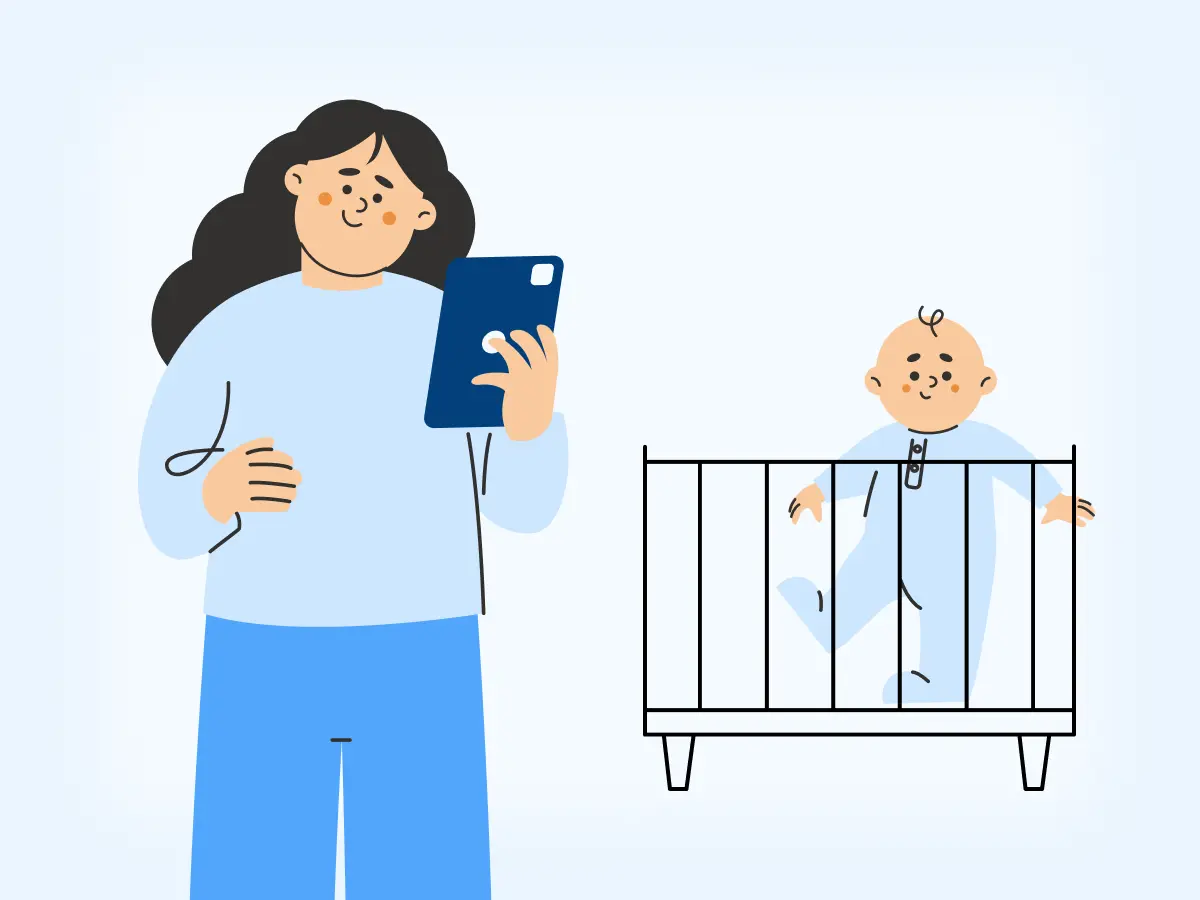
Ensuring babies and children are put to sleep safely is paramount, both in Early Years settings and in the home. There is plenty of information available as to what constitutes a safe sleeping environment, such as:
- The Dfe: Safer sleep: How to provide babies and children with a safer sleep environment in your setting.
- The Lullaby Trust: Safer sleep in Early Years settings
- Foundation Years: Early Years Foundation Stage (EYFS): Safer sleep requirements – Frequently Asked Questions
- You can also download Famly’s guide to safer sleep here.
The EYFS safer sleep requirements
From September 2026, the EYFS has explicit guidance around sleeping arrangements for children in the Early Years.
Sleeping arrangements
3.86 Babies and children must be placed down to sleep safely. For children under 2 years old, the following requirements apply:
- Children must be placed down on their back in their own separate sleep space on a firm, flat surface such as a cot, bed or mattress on the floor. Babies aged 12 months and under must only be placed to sleep in a cot.*
- Sleep spaces must only contain a firm, flat, waterproof mattress and lightweight bedding which is firmly tucked in around the child below their shoulders to prevent head covering. Alternatively, a well-fitted baby sleep bag may be used. Check the manufacturer recommendations before using a baby sleep bag.
- Where blankets are used, the child must be placed feet-to-foot at the bottom of the cot, with blankets tucked in.
- Cots must not contain extra items such as toys, pillows, extra blankets, bumpers, wedges or straps.
- Children should not get too hot or cold. The recommended room temperature for babies is 16 – 20˚C.
- Children’s heads must not be covered.
- Babies under six months of age must always have an adult with them in the same room for every sleep. All children must be frequently checked when sleeping.
- Children must always be within sight and hearing of staff when sleeping.
Practitioners must read NHS advice on Sudden infant death syndrome (SIDS) – NHS. More information on safer sleep guidance is available from The Lullaby Trust.
*Cots refer to: cots, carrycots, Moses baskets, travel cots. Providers may find it useful to refer to the British Standards.
How do Ofsted check on safer sleep practices?
In Ofsted’s Early Years Toolkit, it tells us that inspectors will assess safer sleeping practice under the inspection area of “Children’s welfare and wellbeing”.
“In gathering evidence about children’s welfare and wellbeing, inspectors consider the extent to which…
- Leaders give particular regard to statutory guidance for safe sleeping arrangements, ensuring that this is understood, implemented and monitored consistently for all children, but especially babies and those under 2 years old.
- Practitioners ensure that children, particularly babies and those under 2 years old, are placed down to sleep safely; they consistently put into practice safe sleeping arrangements, including making sure that children are in a safe position for sleeping, that the sleep space, bedding, and temperature are appropriate, and that children are supervised”
Ofsted: Early years inspection toolkit
Recording your sleep checks in Famly
From 1 September 2026, you can add your own notes to any sleep check you record in Famly, helping you meet the new EYFS safer sleep requirements.
When recording your check on a sleeping child, Famly now has an open text field (an empty box) where you can add observations made during the check, according to your setting’s safer sleep policy. For example, you might note:
- The child or baby’s position
- The temperature
- Whether the child was using a dummy or pacifier
- Anything else your setting may require you to check
The sleep check appears on the child’s activity feed, but any notes you add are not visible to parents.

How was this feature developed?
When legislation changes in the Early Years, Famly’s Early Childhood Platform has to change too, so our customers can stay compliant. When Oliva Bailey wrote to all Early Years settings in March 2026 to say the EYFS rules around safe sleep were changing, we knew that meant updating Famly too.
Through conversations with customers on Village, Famly’s online community, reference to the framework itself, and feedback from users, engineers decided on the text box, rather than an entire tick list for each check.
In short:
- The blank text field can be used flexibly, as settings may have different policies and procedures for safer sleep.
- It works for all ages, as the educator can simply make the appropriate checks for the age of the child.
- Famly also allows you to log the sleep check even if no text is added to the box, so that settings can choose to only make a note if something required action. This saves educators from doing unnecessary writing if their setting doesn’t require it.
- A list of buttons to click risks the task becoming a box-ticking exercise, literally, which of course is not the point of the checks.
Oversight of past sleep checks in Famly
As the EYFS only states that children must be checked “frequently”, it will be down to the individual setting’s policy how often that is. So you have complete oversight; you can download a CSV file of previous sleep checks, strtiaght from the Famly app.
To access the download, go to “Reports”, then select “All reports”, then “Sleep”. You simply choose a date range and the report will show:
- Every sleep start
- Every sleep check, including any notes that were added.
- Every nap end recorded
These are logged by the child's name, their room, the time it was logged, and the member of staff who logged it.

Get a personal demo now
Get a guided 1-on-1 tour of the whole platform. See what features are the best fit for you, and ask us as many questions as you like.
Book free demo
