
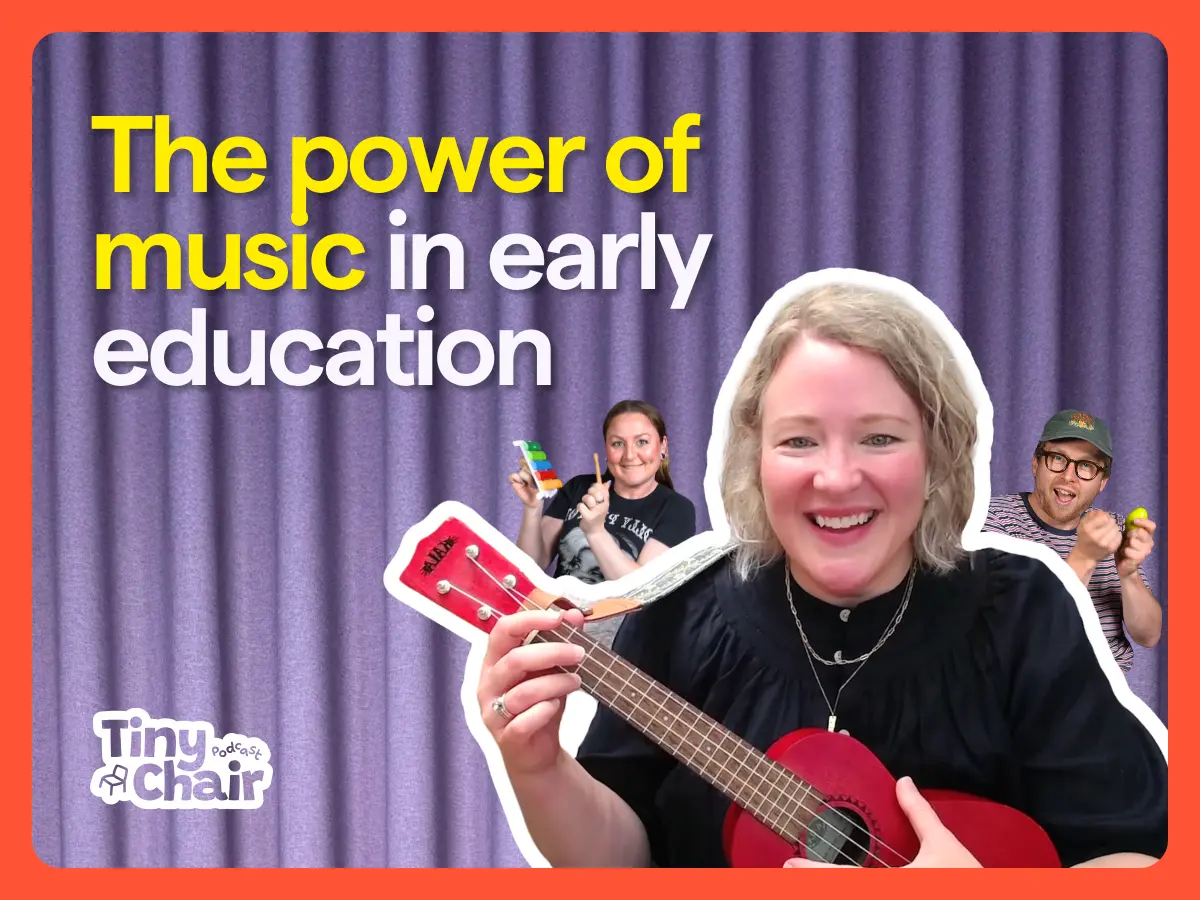
Mary Anderson is the co-founder of My Music Starts Here alongside her husband Mike. My Music Starts Here provides early music education through resources, support for educators, and they even have their own certification. Their mission statement is, "We strive to ensure that all young children, regardless of their race, gender, abilities, location, school, childcare, or socioeconomic status, have the very best music learning experiences that we can provide." Mary was a preschool and elementary school teacher for over 12 years. She's also, of course, a musician and a singer in her own right and has as a bachelor's degree in trumpet performance and a Master's degree in music education.
Music is not a supplementary activity but a foundational learning tool. Music is core pathway through which young children develop:
Mary explains that singing together floods the brain with dopamine, serotonin, endorphins, and oxytocin, lowering stress and building a sense of belonging in the classroom community. Research shows children who make music in Early Years settings develop stronger reading readiness, as they use the same brain regions required for literacy — but in a playful, engaging way.
"I was teaching a special-ed preschool class and I had a precious student, Ethan, who never talked. He was nonverbal. He would grunt occasionally or make little vocalisations, but never speaking words, and I certainly had never heard him speak. One day I decided to hand out ukuleles to all of them. So we're strumming and we start singing "Star light, Star bright", and the kids are just lighting up and they're singing and they're so happy. We must have been singing for probably 5 or 6 minutes, and then all of a sudden, down to my left, I can see him like it was yesterday... Ethan started to sing."
Mary Anderson, My Music Starts Here
Mary also recommedns that educators establish musical anchor points throughout the daily routine. Songs tied to transitions, seasons, and curriculum themes should be woven throughout the day (not confined to a single "music time") to support predictability, self-regulation, and engagement.
Mary believes that music used in early childhood classrooms should align with brain research on what is developmentally appropriate for young children. Loud, electronic-based or entertainment-driven music can overstimulate developing nervous systems, trigger fight-or-flight responses, and undermine self-regulation, particularly for neurodivergent or sensory-sensitive children.
Instead of playing a video of nursery rhymes or songs, Mary recommends just singing! She explains that content you might find on YouTube, for example, is "really coming from more of an entertainment standpoint" rather than a developmentally-appropriate one.
Similarly, Mary recommends Early Years settings Introduce only low-stimulation instruments (like rhythm sticks and egg shakers) as daily classroom instruments. Tambourines and jingle bells should be reserved or avoided, as they risk overstimulation.
Mary says that participation in music should never be coerced or judged, and every child's level of engagement, including simply observing, should be respected. Singling out children for having a "beautiful singing voice" inadvertently communicates to all others that they do not, which can discourage participation.
"If there's a child who's just singing her heart out every day, you know, in private when you're sitting next to her, go, "Man, I love hearing you sing. It makes me happy to hear you sing." But we don't want to focus on the quality of their voice because that defeats the whole purpose. When you're 4, it's not about making this gorgeous, beautiful sound to entertain everybody. It's because you're being human and you're expressing yourself in the most human way, and we're not here to judge that."
Mary Anderson, My Music Starts Here
Many educators, particularly those new to the field, feel reluctant or embarrassed to sing with children. Mary recommends grounding the activity in its purpose (expressing care and nourishing development) as the starting point for building confidence.
And if you're still a little nervous, you can build up to singing in smaller steps, such as:
Mary recommends Dr. Nina Krauss, who runs a sound lab focused on how music organises the brain, and Dr. Anita Collins, based in Australia, who leads an organisation called Bigger Better Brains (BBB) that shares accessible research for caregivers and educators.

Start listening now


