A passionate campaign by the parents of baby Genevieve Meehan, backed by The Lullaby Trust, has pushed the debate about CCTV in Early Years settings to the top of the political agenda. Coupled with other recent tragedies in settings, the government has announced it is considering making CCTV mandatory - but how will it work?
In order to learn more about CCTV use in the Early Years, including reasons for and against a mandate, I met with several settings on both sides of the debate.
- Julia Lymbery, Director at Whitchurch Montessori Nursery and Forest School
Whitchurch Montessori has visual and audio recording inside and outside the setting, including in their forest school. - Alex Nicholson, Owner of Victoria House Nursery
Alex installed CCTV at Victoria House when he took over the setting, around two years ago. - Becky Gibbs, Operations Director, New Foundations Day Nursery and Next Generation Day Nursery
New Foundations Day Nursery has had CCTV for around 15 years. Next Generation Day Nursery has been open for nearly 8 years and has had CCTV since opening. - Corinna Laing, Chief Quality and Operations Officer at Family Adventures Group
The team at Family Adventures Group are working with a university to research how CCTV can be made more proactive than reactive, in Early Years settings. - Nazia Shabbir, CEO, and Maria Sanchez, Founder and Managing Director of Treehouse Nursery School.
Now with four settings, Treehouse Nursery School have had CCTV for over 20 years. - Chris Mullany, Co-founder, The Little Big Nursery
Chris is against the introduction of mandatory CCTV due to cybersecurity and privacy concerns.
What does the EYFS say about CCTV in Early years settings?
The EYFS does not currently mention the use of CCTV, but does cover data protection:
“Records must be easily accessible and available (these may be kept securely off the premises). Confidential information and records about staff and children must be held securely and only accessible and available to those who have a right or professional need to see them.
Providers must be aware of their responsibilities under the Data Protection legislation and, where relevant, the Freedom of Information Act 2000.
Providers must ensure that all staff understand the need to protect the privacy of the children in their care, as well as the legal requirements that exist to ensure that information relating to the child is handled in a way that ensures confidentiality.
Parents and/or carers must be given access to all records about their child, provided that no relevant exemptions apply to their disclosure under the Data Protection Act.”
According to Ofsted’s Guidance: Early years and childcare enforcement policy:
“Providers may choose to use webcams and closed-circuit television (CCTV) to allow parents to see children and to allow managers to monitor staff and children. It is for providers to decide whether these arrangements are appropriate and operated in line with the GDPR, the Data Protection Act 2018, and the Human Rights Act 1998.
The use of CCTV is not covered by the EYFS. Ofsted neither endorses nor prevents the use of CCTV.
If using CCTV means that the provider fails to meet any other requirements of the EYFS, we would take action.
We expect providers to share information with parents on the use of CCTV and how images of their children are stored and destroyed. We would also expect providers to do the same with inspectors on visits/inspections.”
CCTV safeguarding the children
At the top of the list of reasons so many settings install CCTV is safeguarding the children. As Julia Lymbery, Forest School Leader at Whitchurch Montessori, so concisely summed it up, “We say we've got eyes in the back of the head, but we can't always see what happens.”
But a camera can.
Case study: Preventing trauma
If a little girl calls for help from the bathroom, saying she has blood in her underwear, every Early Years educator would no doubt immediately assume sexual abuse. Ordinary safeguarding procedures would necessitate reporting, investigation, the police, social services, and anguish and trauma for everyone involved, especially the little girl.
So why was this time any different? The CCTV.
When staff entered the bathroom, responding to the little girl’s calls, she told them she’d fallen in the tree. That was the cause of the injury to her genitals. But how could staff know for sure that that’s what had happened? Or when it had happened?
Julia Lymbery explains.
“We were able to go back and watch the whole video from the day and noticed that [the little girl] had been to the toilet herself at least three or four times, and she had never called out for a member of staff,” explains Julia, “But the last time, she recognised that blood was in her pants and she was the one who alerted us to it.”
In the safeguarding review, the team were able to document that the first three times the little girl went to the toilet, she didn't call for a member of staff. She went outside, then came in, and then she called for the teacher.
“We were able to look at that CCTV and see the moment in which she fell in the tree, and the fact that it was 20 minutes later she went to the toilet,” says Julia, “So it literally gave a timeline with all the evidence captured.”
The team were able to send the footage to the parents, to share with the professionals in the hospital, exactly macthing the little girl’s description of events. Becasue of the clear evidence of an innocent explanation, no safeguarding concern was raised.
However, CCTV cannot work alone.
A golden thread through all the settings with CCTV that I spoke to was that, despite their enthusiasm, they were all very clear that it cannot work without a robust safeguarding culture. So how do leaders with CCTV maintain the idea that ‘it could happen here’?
- Keeping safeguarding at the heart of everything - “Safeguarding is and always will remain a thread through everything we do,” says Julia of Whitchurch Montessori, “We use the cameras to support an environment that we've already created.”
- Being present in the rooms - Nazia of Treehouse Nursery explains, “We are checking the cameras every day, but we are very much hands-on in the rooms. Our managers are not office-based - we have a policy where our managers have to be in the rooms monitoring and observing the children and the staff’s practices. That’s what we stand for. The children's safety and their welfare is the priority.”
- CCTV complements culture, it doesn’t replace it - "CCTV supports the wider safeguarding framework rather than replacing it,” says Alex of Victoria House Nursery. “It’s important that settings don’t become complacent and assume that simply having CCTV means nothing can go wrong. The most important safeguards are still well trained staff and a strong safeguarding culture embedded throughout the setting."
Becky, Operations Director of New Foundations Day Nursery, says that their team are questioned on safeguarding every day, in order to keep that knowledge top of mind.
“Usually, as the team first arrive or when they're setting up their rooms, the manager or the deputy will go around and choose different staff each day to ask three questions. One's always around safeguarding, one's around first aid, and one’s around education. It’s to constantly keep people on the ball. Safeguarding is always going to be on the mind; it's always going to be a high priority. And, the staff who aren't questioned are still hearing the questions, so it's refreshing them at the same time.”
At Family Adventures Group, the team have multiple ways to whistleblow, should anything feel not quite right.
“Every day, our employees mark how happy their day was out of 5, and they can give some comments as well, “ says Chief Quality and Operations Officer, Corinna, “That is an avenue for somebody to say, ‘I need to speak to someone.’ We also have CPOMs, which integrates with Famly, so that's another way to note a concern. But what we try to do is talk about ‘gut feelings.’ For us, you can have all the policies and paperwork in place, but actually, if a member of staff has a gut feeling that something isn't right, we'll listen to that as much as hard evidence. You have to. As long as you've got that culture where people can talk out.”
The sentiment of a safeguarding culture being the key was echoed by Chris, the co-founder of The Little Big Nursery. However, he believes that a strong and robust safeguarding culture doesn’t require CCTV as well.
“In theory, if you recruit the right person, you train them the right way, and they're aware, none of these issues should ever occur,” says Chris, “So what's a camera going to do except show you the evidence after the fact? And, if you've got good staff, those reports, those write-ups, those interviews after an incident should be sufficient.”

CCTV safeguarding the adults in settings
For many educators in settings operating without CCTV, the thought of suddenly being observed at all times could feel a bit daunting.
Chris of The Little Big Nursery worries that mandated CCTV could negatively affect staff morale in an already difficult recruitment climate. He prefers that his team be vigilant and support one another to keep everyone safe
“Say there's a door ajar. Someone walks past, closes it, and just gives the person a little reminder through the glass. They're doing it for themselves, and they're doing it for each other,” he explains, “But the minute I say, ‘I'm going to put cameras in’, the translation is, ‘I don't trust you. I don't believe in the training I've been giving you, and I also don't care about your morale’. That element has got to weigh in. We're in a recruitment crisis. The sector under-recruited by over 10,000 in the last year, and we're going to tell everybody else, ‘We don't trust you. We're going to film you’?”
However, the leaders I spoke to with CCTV all felt that their teams have embraced the cameras as part of the fabric of working in the nursery.
“When I first introduced CCTV, I was mindful of how the team might feel about it,” says Alex of Victoria House Nursery. “I didn’t want it to feel intrusive or as though staff were being monitored unnecessarily. In practice, the team have been very supportive and recognise that it also protects them and provides clarity when questions arise.”
Becky, the Operations Director at New Foundations Day Nursery, agrees, “The staff were definitely nervous when we first had it put in because they were worried about what it meant. Did it mean that management would be staring at the screens all the time, watching every move that they made? But they don't bat an eyelid anymore.”
Case study: Refuting false allegations
Without CCTV evidence, allegations can be a case of one word against another. Luckily for the team at Treehouse Nursery, the CCTV was able to show exactly how an incident had played out.
“A parent made an allegation against a member of staff where their child had suffered an injury,” explains Nazia, “When we went back and checked on the camera, it was very clear that the child had dropped on the floor because she pulled a tray out. We showed the parents, and they were then satisfied, knowing it wasn't the member of staff. It was just the child who accidentally dropped on the floor that hurt their elbow. In that case, it was definitely a lifesaver.”
The CCTV was able to prove what had happened, beyond just the staff member’s word. Because of the CCTV evidence, the case was closed. The staff member could prove without doubt that they’d done nothing wrong.

For Becky, the team knowing someone is watching isn’t a bad thing. The settings also have a no lone working policy, so staff always have someone close by.
“As a management team, we don't have time to just sit down and watch a screen all day,” says Becky, “But this shouldn't be something you worry about - you should always be acting as if someone's watching. That should just be part of your normal routine. We want you to act as if you are always being observed by the parents. We want you to act as if you're always being observed by us because that should always be your standard.”
Reactive versus proactive CCTV
When accidents happen, and it’s time to fill out the accident report, we often have to rely on memory or, if an educator didn't catch what happened, a child’s description. However, Alex's team at Victoria House Nursery have the CCTV to show them what actually went on.
“In practice, we’ve used CCTV quite differently to how I originally expected,” explains Alex. “Its most valuable use has been reviewing minor accidents or incidents. It allows us to check exactly what happened so that when we complete an accident report on Famly, we can ensure the information we share with parents is accurate and complete.”
However, new research could mean that CCTV can detect an accident or incident before it’s even happened, as Corinna Laing of Family Adventures Group explains.
“Using AI technology, we'll be able to identify something that's going to happen before it happens,” says Corinna, “For example, say a child picks up something that they're allergic to, and it’s in our system that the child has that allergy. There'll be an alert to say, ‘Little Johnny's about to eat some bread, and he's got a gluten allergy.’ We’ve just gone into this project, we're just about to launch it and start all the research. So it's very, very early days. But we want to make it much more proactive and help us identify risk within nurseries before it happens.”
CCTV and improving practice and provision
Although it sometimes feels that we’re expected to, Early Years staff can’t be everywhere at once. However, for the team at Treehouse Nursery School, this isn’t a problem. Having CCTV means the leadership team can view any (or all) of their four settings, and multiple rooms at the same time.
Recently, they’ve been working on improving their meal time provision, as Nazia explains.
“We have all six rooms, from the baby room up to five years old, and we see how the meal times are happening in each room at the same time. We physically can't be in every room; it's impossible. But we can review the practice by looking at the CCTV camera and say, ‘Right, managers, this is what we need to work on. This is where the areas of development are, or these are the things we need to strengthen.’ Or, ‘Let's praise this team now. They've done really, really exceptionally well,’ and that really, really has helped.”
There’s nothing like having an expert eye look over something to see how you can improve. Unfortunately, you don’t always have an expert on hand when you need one.
But that’s no problem if you’re recording everything.
At Whitchurch Montessori, they shared their recent emergency evacuation drill with their fire safety officer, who only visits twice a year.
“We said, ‘Could you just watch the CCTV footage here of this?’” says Julia, “‘Have you got any advice on what we're doing? Are there any ways that we can improve that? Is there any way we can speed that up?’”
Without having been on site at the time, the fire safety officer could offer feedback on the drill, possibly saving precious seconds during a real emergency evacuation.
Case study: learning a new way to play
Sometimes, a live observer can disrupt a child’s experience or routine, but of course, new staff have to learn somehow. That’s where the team at Whitcurch Montessori use CCTV. The video and audio recording means that a member of staff can watch a session back to see how it’s done, without being present at the time.
“We run ‘bucket time’ with our severely autistic children,” says Julia, “But if somebody were to observe in the same room that they do bucket time in, it would distract our autistic child because that's not the routine that he's used to. He's used to him, his practitioner, and when they get stage two or three, a couple of other children, but if you put another adult in that situation, it's a distraction. So, when we're trying to teach our apprentices how bucket time runs, they can watch the videos. We don't interrupt the child's focus, and they can still learn how to do it.”
What about the cost of installing CCTV in Early Years settings?
In a sector with margins as tight as the Early Years, how can settings afford an expense like the installation of CCTV?
For the settings I spoke to with CCTV, the investment in safety and peace of mind far outweighs the initial outlay financially.
“Let's not also forget, it's a one off cost of installation, not an ongoing monthly cost,” says Nazia of Treehouse, “It may be a chunk of money up front to install the cameras, but once they're installed, you just need to make sure that you have enough storage, or sometimes get an engineering to fix a broken camera. There's not a fixed cost every month.”
However, Chris of the Little Big Nursery asks whether the budget for CCTV could be better spent on training.
“CCTV’s been proven not to be a deterrent; it can only provide you with evidence after the fact. If you're in two minds about CCTV and you commit resources that could go towards the betterment of children's experience, remember where the priority is,” advises Chris. “Could you mitigate your safeguarding concerns with better in-house or external training, or more frequent supervisions? Could that be money better spent?”
CCTV, privacy, and data protection
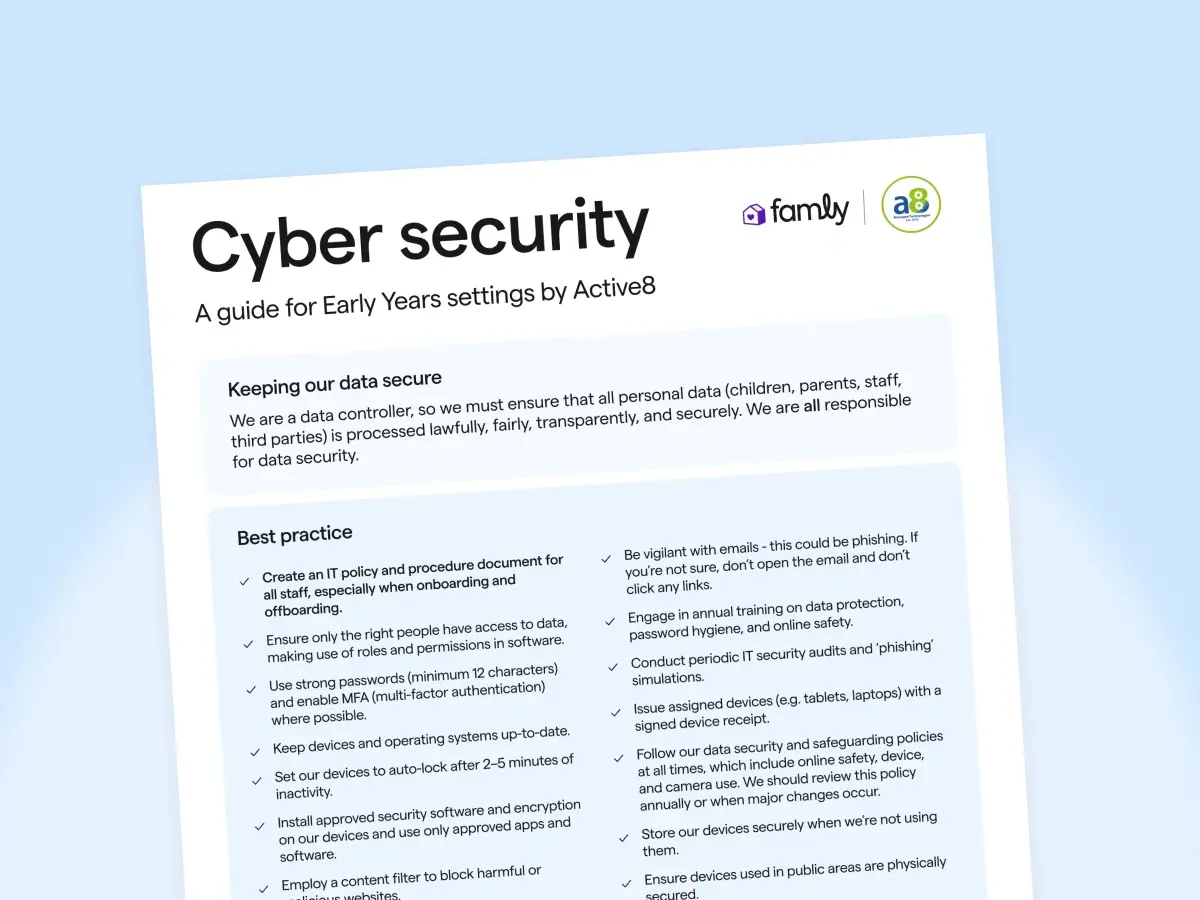
Central to all of this is keeping everyone safe, and that means data protection too. Chris of The Little Big Nursery is concerned that a lack of confidence in strong cybersecurity practices could leave CCTV in settings vulnerable to data breaches.
“The rationale is perfectly sound, we want to improve the situation around safeguarding,” says Chris, “I get it, but at the same time, this is going to be hugely more dangerous if there isn't sufficient training, and there aren't sufficient safeguards in place. If you make this mandatory and a setting has no clue what they're buying, they just put in a cheap little system that's somehow sharing outside the business, or it's vulnerable to attack, you've created a bigger problem.”
Chris’s background is in IT, so he recommends that those considering CCTV first think about:
- Gaining a Cyber Essentials certification, if you don’t already have one
- The training required to use the system in line with data protection and GDPR (including subject access requests)
- The level of cybersecurity skill and knowledge already in the organisation
- Rules around registering CCTV with the ICO
- Legal culpability and insurance
- Where the recordings will be stored (In the cloud? On a local device?)
- Whether the devices they plan on using are for domestic or business use
It’s also important for settings to consider children’s physical privacy, such as by not installing cameras in the bathrooms or preventing nappy changes from being recorded. Just as where CCTV is not present, children’s dignity, privacy, and safeguarding have to be carefully balanced.
“We've got nappy changing in the room and cameras facing the whole room,” says Corinna of Family Adventures Group, “But we have privacy blocks, a little black rectangle, that covers the child. You can still see what the practitioner is doing, but you're preserving the child's dignity.”
Creating an Early Years CCTV policy
Whether CCTV is mandated or not, you’ll need a policy around its use. So what should your policy include?
- The purpose of making the recordings
- Where the cameras are
- Privacy considerations, such as signage to inform parents and carers, staff, and visitors that you have CCTV, or not recording intimate care routines.
- Information about how you keep the footage secure
- Information about how long you keep the footage, and how and when it’s deleted.
- Who has access to the footage and recordings, when, and why
- How you handle Subject Access Requests (SAR)
- Registration with the Information Commissioner’s Office (ICO).
- How footage may be used to investigate incidents, accidents, or safeguarding concerns
- Who the footage may be shared with, for example, the police or the LADO.
“The policies are very, very clear as to what the CCTV is used for,” says Nazia of Treehouse Nursery School, “We use these cameras to monitor and safeguard everybody who is working in the setting. We’re also very transparent with parents that we will show them the footage, but make sure that the identity of the other children is concealed.”
Corinna Laing adds that at Family Adventures Group, they keep a log of who’s logged in to view their cameras, and why.
“Every nursery has a log, and if you view the cameras, it has to be recorded because you have to have a legitimate reason,” she explains. “We put that in place because you can't just view them for the sake of it and we don't want managers in the office watching everyone's practice on CCTV.”
For parents and carers, especially, setting clear boundaries around who can view the CCTV is essential, as Becky of New Foundations Day Nursery explains.
“We do have a strict policy about not allowing parents to view it because obviously it contains other children, and that's violating their privacy,” says Becky, “We've had parents that have pushed back a bit on that before, but we’ve explained, ‘This is our policy because we have to protect all the other children. We're not hiding anything from you.’ But that's probably only happened on one or two occasions in the 15 years or so that we've had the CCTV.”
A community benefit
“We’ve had our CCTV come in handy to support the police with investigations,” shares Nazia of Treehouse Nursery School.
“Because we have cameras at the front, we have cameras down the alleyway, we have cameras in the garden. We literally have cameras everywhere, covering 360° of the buildings. We've had the police come into my office a few times and say, ‘Can we check the cameras, please? We’re in the neighbouring area, and we've seen that you've got CCTV cameras. Can you help us identify these people?’ It's assisting them at the same time as well.”
Will Early Years settings have to install CCTV?
In short, we don’t yet know for sure.
At the beginning of this year (2026), the Early Education Minister, Olivia Bailey, confirmed that the Government is considering mandating the use of CCTV in Early Years settings, as part of broader safeguarding reforms.
During a February parliamentary debate, the minister gave further details about the promised advisory panel, which will inform new safeguarding guidance in the Early Years. She said that the panel “will consider key points, including, but not limited to,
- Whether CCTV should be mandated in early years settings,
- CCTV’s role as part of a setting’s wider safeguarding measures,
- how CCTV and digital devices should be managed to ensure that children’s privacy is protected alongside their safety,
- What systems, training and safeguards are necessary to address concerns such as cybersecurity and the possible misuse of images?”
But will it solve safeguarding problems in the Early Years? Corinna of Family Adventures isn’t so sure.
“CCTV is only used reactively, so I'm not sure that putting CCTV into nurseries and making it mandatory is actually going to solve any problems,” she explains. “It's useful for investigations, it's useful for parent complaints, but that's after an event, not in the here and now. I think if we can make it more proactive, then that's the way forward with CCTV. And, if they're going to mandate it in nurseries, there needs to be a whole load of other things that go around it.”
Chris of The Little Big Nursery agrees, “As far as we're concerned, there are a lot of lower-hanging fruit to deal with this issue first. It’s jumping to put an already stressed industry under more stress, both financially and from a compliance point of view. We need to look at very, very hard at the legislation, at the training, and the execution on safgeguarding before we jump to a technological response.”
Who will be on the safeguarding panel to inform guidance about CCTV?
Early Education Minister, Olivia Bailey, has stated that the panel will involve representatives from:
- The Department for Science, Innovation and Technology
- The Home Office
- The Information Commissioner’s Office
- The Office of the Children’s Commissioner
- The National Police Chiefs’ Council
She has further stated that the review will involve the voices of:
- Early Years providers
- Academic experts in Early Years safeguarding
- Experts in surveillance technology
- Parents
Resources about CCTV in Early Years settings
- The Information Commissioner’s Office (ICO): Data protection tips for Early Years settings: What to do with your CCTV footage
- The Information Commissioner’s Office (ICO): A 10 step guide to sharing information to safeguard children
- The Information Commissioner’s Office (ICO): Checklist for limited CCTV systems
- The Information Commissioner’s Office (ICO): Video surveillance guidance (including information for organisations using CCTV)


Top tips from Alphabet House
Get top tips from a setting just like yours. Hear from Alphabet House on why and how they use Famly - and why they’ve never looked back.
Read their story